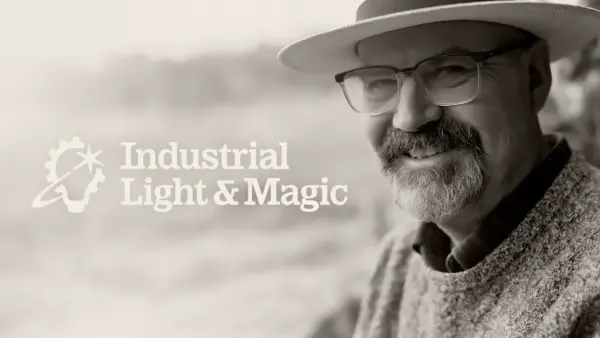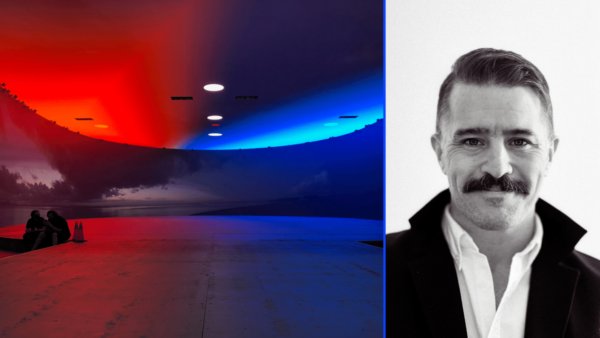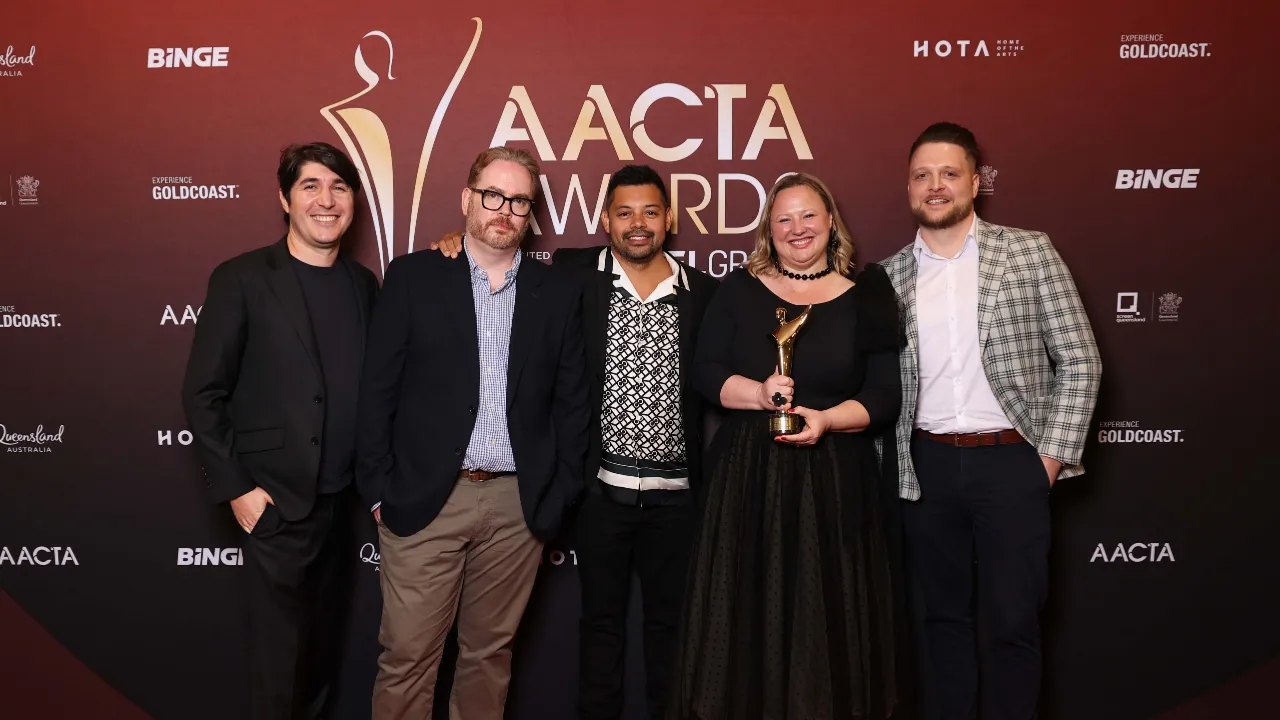
From childhood moviegoer to award-winning Visual Effects Supervisor, Jeff Capogreco’s career traces a full-circle journey through the worlds that first inspired him. Now a key creative force at Industrial Light & Magic in Sydney, he has helped bring to life major productions including Star Wars: The Rise of Skywalker, Avengers: Infinity War and Jurassic World Dominion. Most recently, his work on Tron: Ares earned him the AACTA Award for Best Visual Effects or Animation, alongside an Emmy-winning turn on Star Wars: Skeleton Crew. In this Q&A, Capogreco reflects on the early influences that set him on this path, the process of building cohesive digital worlds like the Grid, and the collaborative, global effort behind some of today’s biggest screen stories.
How did you get started in Visual Effects? What was the journey to getting to where you are now?
My interest in visual effects began before the industry was clearly defined. Watching films like Jurassic Park and Terminator 2 as a kid, I was completely mesmerised. I didn’t understand how those images were made, but I knew I wanted to be part of it.
Growing up in rural Alberta, a career in film felt unlikely. But discovering that visual effects were created on computers opened a door – I realised I could contribute through technology, which I was already passionate about.
I studied new media in Edmonton, developing skills across photography, video, editing, digital imaging and coding. After graduating, I helped build a media program at a local college while teaching myself 3D graphics and building a portfolio.
I later moved to Ontario and applied to Sheridan College. Initially rejected, I was accepted off the waitlist in the first week. I quit my job, relocated immediately, and committed fully.
For my final project, I created a live-action short shot on 16mm, compositing WWII-style aircraft into the footage. That led to my first role at CORE Digital Pictures on The Wild, working under Steve Williams. I started in environment modeling and texturing before moving into lighting, gaining a strong understanding of the full pipeline.
I went on to work across North America before moving to New Zealand for Avatar. What was meant to be a year turned into seven, and I quickly progressed to lead lighting, supported by my broad technical skillset.
Later, I joined Industrial Light & Magic in Singapore to work on Jurassic World — a full-circle moment, returning to the franchise that first inspired me. Since then, I’ve continued working on projects that blend technology, storytelling and the sense of wonder that drew me to visual effects in the first place.
You recently won the AACTA Award for Best Visual Effects or Animation for your work on Joachim Rønning’s feature film Tron: Ares. How did you and the team approach bringing the grid to life?
Winning the AACTA Award for Best Visual Effects for our work on Tron: Ares was incredibly rewarding, especially alongside my Sydney colleagues Tomasz Wachnik, Alex Popescu, Jhon Alvarado, and Kacy McDonald. Our goal was to bring the Grid to life in a way that felt both faithful to the franchise’s legacy and grounded in believable technology.

One of the core ideas was treating many of the Grid’s processes as if they were manufactured systems rather than pure magic. In the Dillinger Transfer Bay, for example, we developed a laser-printing process inspired by real-world 3D-printing techniques. The animation team first choreographed the lasers in playblasts to establish the editorial rhythm, essentially defining what was being “printed” and when. From there, our FX team built a custom procedural system that could grow the structures in sync with that choreography. As the lasers scanned across the space, they generated modular support jigs that formed around the objects in clean, Tetris-like sections. The materials were designed to resemble brushed, slightly iridescent metal, while volumetric smoke and contact sparks helped convey heat and industrial energy. When the printed objects finally broke free, the system transitioned into what we called the “Black Sand” phase, where the solid metal structures disintegrated into fine granular particles that dissolved into the floor.

We also built a complex “timeout” effect for programs and vehicles reaching the end of their lifespan. Originally pioneered by the Vancouver team, the effect transitioned fractured rigid bodies into dense point clouds and eventually granular particles. For close-ups, we carefully match-moved the actors so we could precisely time the decomposition of different materials (skin, light lines, helmets, and suits) at slightly different frequencies. Additional 2D treatments gradually desaturated the characters’ skin as the illuminated lines flickered and revealed depth beneath the surface. When jigs or structures timed out rapidly, the process accelerated into extremely fine micro-particles that left behind a faint layer of smoke before fully dissipating.
Environment design was another major component of making the Grid feel tangible. The Dillinger fortress, for example, sits atop an endless Voxel Ocean, where grid patterns subtly refract beneath the surface. The design originated from striking concept art, and our environment team took cues from real dockyards and industrial infrastructure to inform the layout. We also drew inspiration from GPUs and motherboards, where the forms and circuitry of real computing hardware became visual motifs across the architecture. Surrounding the fortress was a vast industrial grid designed to mass-produce Dillinger tech, populated with cranes, cargo recognizers and steam-venting factories to give the world a sense of constant activity.

Some sequences were shot using an ILM StageCraft LED volume, particularly the mountain test site. We created bespoke digital environments that played directly on the LED walls during filming, which helped ground the lighting and reflections. In post, we extended the environment beyond the physical volume, adding elements like snow, breath vapor, and atmospheric effects while subtly shifting the lighting toward the warmer sunset tone the filmmakers wanted.
We also had moments that paid homage to the franchise’s origins. The digital orange tree sequence was inspired by the transformation imagery in the original Tron. We modeled the tree from real-world references, but its growth animation incorporated wireframe structures and bounding boxes reminiscent of the 1982 grid aesthetic. Laser beams triangulate and build the form piece by piece, visually bridging the early graphical language of the franchise with the more advanced digital systems in Ares.
For high-speed skimmer sequences across the voxel water, the animation team studied real-world speedboat dynamics and camera behavior to capture the sense of velocity. Our FX team simulated a massive roostertail wake made of pixel-sized bioluminescent cubes, driven by custom velocity fields derived from real propeller dynamics. The light itself was generated procedurally from particle data, modulated by vorticity and acceleration, so the wake flickered with subtle energy as the vehicles moved at extreme speed.

Across all these elements – printing systems, particle-based timeouts, voxel environments, and stylized lighting – we tried to treat the Grid as a coherent digital ecosystem. Every effect was designed to feel like a natural extension of the world’s underlying technology, helping ground the spectacle while still maintaining the iconic visual language that audiences expect from Tron.
In a big year of recognition, you also won the Children’s and Family Emmy Award for Outstanding Visual Effects for a Live Action Program for your work on Jon Watts and Christopher Ford’s Skeleton Crew. What were some of the most exciting parts of that work for you?
Working on Star Wars: Skeleton Crew was an incredibly fun experience. I think any Star Wars fan knows that the heart of Star Wars has always been its appeal to younger audiences. What made this project special was the opportunity to modernise that idea and explore the galaxy through the perspective of children, while still keeping the sense of adventure and wonder that defines the franchise. Pulling that off in a way that felt both fresh and authentic was no small feat.
The showrunners, Jon Watts and Christopher Ford, were incredibly collaborative and very respectful of the visual effects process. They trusted Industrial Light & Magic to bring strong ideas and visual direction to the table. That level of trust made a huge difference creatively, because it allowed the team to explore solutions and develop visuals that really enhanced the storytelling.
One of the most memorable aspects of the project for me was working across three ILM studios around the world. I originally began the show in Singapore with the team there. Unfortunately, that studio closed during production, and I was transferred to Sydney, where I continued the work the Singapore team had started and picked up additional sequences already underway in Australia. At the same time, our Mumbai studio joined the project for their first Star Wars production, and I had the opportunity to help guide that team through the process as well. Seeing artists across three studios and multiple time zones come together to build something at this scale was incredibly energising.

Another highlight for me was working with John Knoll. He’s someone I’ve long looked up to as a mentor. John has a leadership style that I really appreciate in that he isn’t a micromanager. Instead, he’ll give you a clear idea or brief and trust you to find the best possible solution for the shot. That level of trust encourages creativity. Often, when artists are given that freedom, they can explore ideas that might not have been considered initially and ultimately improve the final result.
One particularly fun aspect of the project was that John shot a number of practical miniatures using motion control techniques, very much in the spirit of the original Star Wars: Episode IV – A New Hope era. Integrating those miniature elements with modern CG work was fantastic. It felt like a bridge between the classic filmmaking techniques that defined early Star Wars and the modern tools we use today.
Moments like that are a big reminder of why this work is so enjoyable. When you’re collaborating on something this creative and nostalgic, it genuinely doesn’t feel like a job.
Visual effects is always a team effort, so being recognized with an Emmy Award for Outstanding Visual Effects was an incredible career highlight. More than anything, I feel privileged to represent the many talented artists and technicians who worked so hard on the show. Their dedication is what made the work possible.
What have been the highlights of your career in Visual Effects so far? What are you most looking forward to?
I’ve now been at Industrial Light & Magic for over 11 years, going on 12, and it’s been an incredible journey. Sometimes I stop and ask myself how I’ve been lucky enough to work with so many talented artists and mentors. These are people I looked up to long before I ever imagined working alongside them.
My direct supervisor is Rob Coleman, and much like John Knoll, he was someone I admired during the days of the Star Wars Prequel Trilogy. I remember sitting at my desk in college, fascinated by the process of visual effects and how artists like them were solving seemingly impossible problems on screen. The fact that I now get to interact regularly with people like Rob and John is still pretty amazing to me.
Another highlight has been the opportunity to work with Doug Chiang. I grew up being inspired by his concept art and designs during the prequel era, and now, after having worked on six Star Wars projects, even just getting the chance to see him work up close is incredibly inspiring.
Along the way, I’ve also had the privilege of collaborating with some incredible supervisors on major productions. These are people like Jeff White on Kong: Skull Island; Roger Guyett, Patrick Tubach, and Nigel Sumner on Star Wars: The Rise of Skywalker; and Jason Smith and Scott Farrar on the Transformers film series.
Working with Eddie Pasquarello on Obi-Wan Kenobi and Star Wars: Skeleton Crew was also an incredibly collaborative experience. I also had the chance to contribute to Avengers: Infinity War with Russell Earl and Jurassic World Dominion with David Vickery.

These are people who have been hugely influential in the industry, and in many ways, they were role models I hoped to emulate earlier in my career. Getting to know them and work alongside them has truly been a privilege.
More recently, working with Vincent Papaix and David Seager on Tron: Ares, alongside Sydney studio leadership, including Alex Popescu, Tomasz Wachnik, Kacy McDonald, and Jhon Alvarado, made for an incredibly rewarding project and one I’m very proud to have been a part of.
Outside of my time at ILM, some of my personal career highlights go back to earlier projects. When people ask which shows were my favorites to work on as an artist, I often think about Avatar. It was an incredibly exciting time in visual effects. The technology was cutting-edge, and it was incredibly satisfying to help create images that were so groundbreaking and beautiful at the time.
Another major milestone was supervising the Golden Gate Bridge sequence on Rise of the Planet of the Apes, which was my first opportunity to step into a visual effects supervising role alongside Erik Winquist at Weta Digital. It was both daunting and incredibly exciting, and that experience eventually led to supervising work across all three films in The Hobbit Trilogy.
One of the characters I especially loved working on during that time was Gollum. I remember reading about him as a kid in The Hobbit and being fascinated by his strange, creepy personality. Helping modernize and refine that character after the work done on The Lord of the Rings film trilogy was both intimidating and incredibly rewarding. I’m really proud of where we ultimately took that character and how well it translated to the screen.
Looking ahead, what excites me most is continuing to collaborate with talented artists and help push visual effects forward. Technology keeps evolving, and there are always new creative challenges to solve. Being part of that ongoing evolution – and helping the next generation of artists grow in the process – is something I’m really looking forward to.