Australian visual effects studio Future Associate delivered more than 150 visual effects shots for the period action film The Bluff, spanning everything from fire and smoke simulations to large-scale environment builds and digital character work.
Working closely with production VFX supervisor James McQuaide, the team helped realise several of the film’s defining moments, including the destruction of Bodden House, the creation of the towering cliffside environment known as “the bluff,” and a brutal cannon execution sequence.
Produced by Amazon MGM Studios and directed by Frank E. Flowers, The Bluff follows a Caribbean woman whose hidden past resurfaces when ruthless pirates invade her island. Starring Karl Urban and Priyanka Chopra Jonas, the film was shot in Queensland and premiered at No. 1 on Prime Video.
Following the film’s release, Future Associate shared a VFX breakdown video revealing how the team helped bring many of the film’s environments and action sequences to life. We caught up with Founder and VFX Supervisor Lindsay Adams, who unpacks the creative and technical challenges behind the work, offering insight into how the team completed some of the film’s most prominent components.
Burning Bodden House
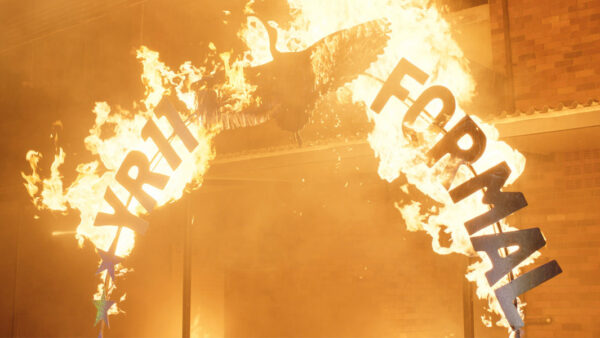
One of the most technically demanding sequences involved the destruction of Bodden House: a Caribbean building with a distinctive thatched roof that becomes engulfed in flames as pirates pillage the island.

According to Future Associate founder and VFX supervisor Lindsay Adams, making the fire feel believable was one of the project’s biggest challenges.
“Making the house fire sequence look convincing was a huge undertaking. There’s no compromise for a film like this where visual effects have to go unnoticed. Every frame has to be absolutely photographic.“
Lindsay Adams, VFX Supervisor
The production supplied the team with a detailed LiDAR scan of the structure, captured by McQuaide during filming. This scan gave the team an accurate digital model of the building, however, they still needed to create the structure of the roof and the interior beams before moving onto the flames.
Using that data, the team rebuilt parts of the roof structure digitally before running smoke simulations and integrating real fire and ember elements from their in-house library. The sequence also required careful choreography as the flames spread through the scene.
“There’s a progession to the burn. The first starts when Captain Connor throws the torch onto the roof. He walks past the camera with a prop torch that has a light on the end, and we tracked that torch and created the fire simulation from there,” Adams explains.
The proximity of the camera meant the effect had to hold up under close scrutiny.
“Fire can behave erratically, so attention to detail is key. As the flame passes right in front of the camera, there is no room for error.”
Lindsay Adams, VFX Supervisor

In some moments, the digital work transitions into live-action fire elements once the flames take hold and become more static, helping maintain realism as the structure begins to burn.
Creating the titular bluff
The towering cliff that gives the film its title appears throughout the story and became a key visual anchor for the environment.
Future Associate constructed the hero cliff or the titular ‘bluff’ using location photography and reference scans captured during production.
“James scanned and photographed a real rock face and we built that in CG. We alternate between the CG version and matte-painted versions depending on the shot.”
Lindsay Adams, VFX Supervisor
Fellow Ausfilm member Myriad Studios were hugely important in the scanning process, supporting VFX Supervisor James McQuaide to deliver exceptional on-set capture, which involved overcoming several challenges in the process, including: reploying a scan truck to remote island, and using drone-LiDAR to scan Cayman Island cliffs during a hurricane. Further employing their scanning technology, the team were also responsible for capturing 160 cast, extras and a range of weapons for the film.

The environment appears across multiple scenes filmed at different times of day, which meant the team had to carefully match lighting and atmospheric conditions.
“A scene might start filming in the early morning and then the next shot could be midday or sunset. Even though the scene plays out in a minute or two, the lighting can change dramatically. Accounting for those changes was important in maintaining continuity.”
Lindsay Adams, VFX Supervisor
To handle this, the team created a fully digital version of the cliff so they could adjust lighting direction and environmental conditions shot by shot.

One particularly important moment is a night establishing shot that connects the house to the cliffside landscape. “The filmmakers needed a shot that connected the house to the bluff,” Adams explains. The shot required extending trees, adjusting the landscape and removing equipment that was visible during filming.
For Adams, the bluff represents some of the team’s most satisfying work on the project: “It looks photographic. It’s not something the audience would hook onto as being made using visual effects.”
Ships, seas and pirate landings
Future Associate also contributed to several maritime sequences across the film.
The ship Kirconnell appears in dry dock undergoing repairs. The team extended parts of the vessel digitally – including mast and rigging – while removing temporary production structures that were visible during filming.
“Set extensions and clean-up are our bread and butter,” Adams says. “It’s invisible work to the audience but important nonetheless.”
Lindsay Adams, VFX Supervisor
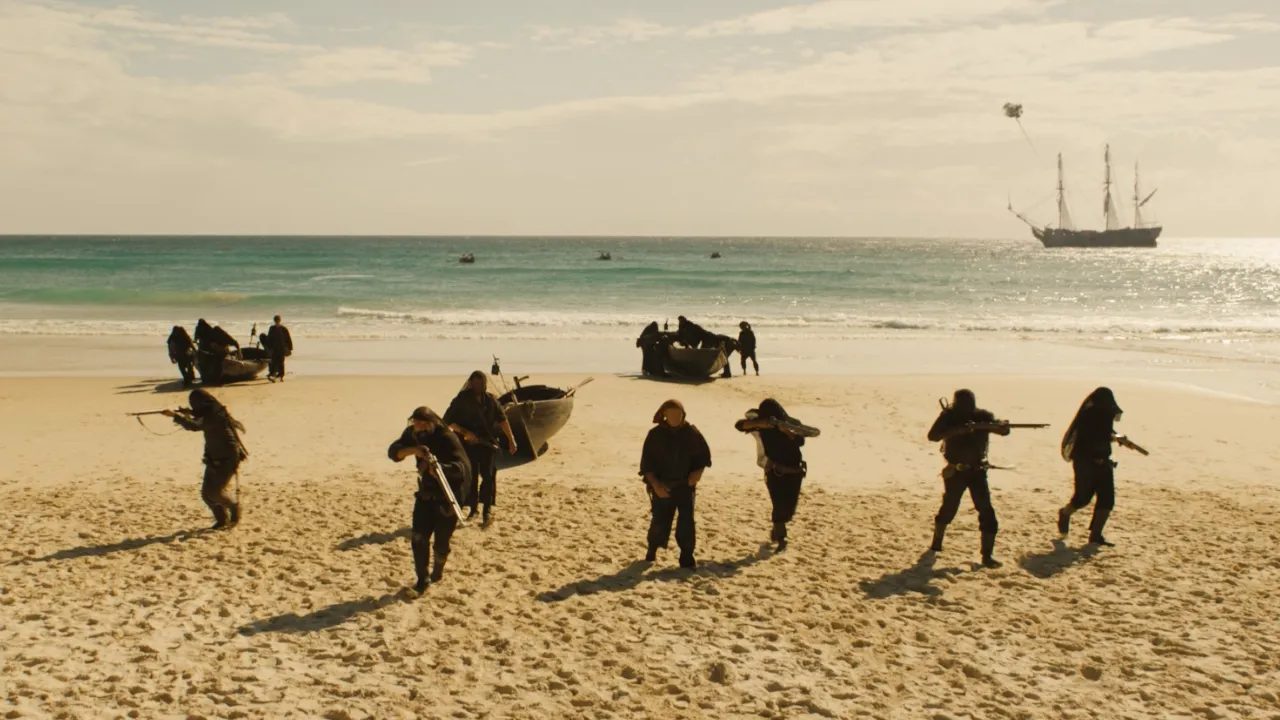
For the pirates’ landing sequence, digital doubles of several characters were created using scans of the actors. These were placed into three computer-generated rowboats approaching the island from Captain Connor’s ship, helping populate the sequence and clarify the geography of the attack.
Connor’s ship itself was created by the team at Rising Sun Pictures, who shared the asset with Future Associate. “Rising Sun built Connor’s ship and did a tremendous job. They provided the high-detail asset and we integrated that into our pipeline so we could animate, light and render it for our shots,” Adams explains.

The asset sharing allowed both teams to maintain a consistent look across the film’s ship sequences.
“Assets swap hands a lot between vendors. We collaborate with other VFX companies across projects all the time.”
The ship also appears in a tense opening sequence where it emerges from darkness in a violent storm. Adams reveals: “That sequence came to us late in the process. We had to add Connor’s ship in the background of a few shots and build big rolling waves during the fight scene.”

Heightening the violence
The film’s gritty tone also meant Future Associate contributed to several violent moments, including a particularly brutal cannon execution. Although the production filmed practical elements for the scene, the moment needed additional visual effects to clearly communicate what was happening.
“There’s a part of the film where a character gets torn apart by a cannonball. The scene was slightly out of focus in the background, so to get a clear read on what was happening we had to create it in CG,” Adams remarks.
The team built digital doubles of the characters involved and simulated the impact, helping heighten the shock of the moment.

Gunfire throughout the film also required careful attention to historical accuracy.
“James shot a lot of period-accurate muzzle flashes,” Adams explains. “Firearms of that era produce two distinct flashes, one from the muzzle and another from the primer. Using those elements helped us get the look right and deliver what the filmmakers intended.”
Lindsay Adams, VFX Supervisor
Those flashes, along with smoke elements captured on set, were integrated into shots at the correct angles and matched to the camera lenses used during filming.
Existing infrastructure and an evolving pipeline
Future Associate’s work on The Bluff also relied heavily on the studio’s evolving internal pipeline and visual effects library.
The company maintains a large archive of fire, smoke, water and atmospheric elements that can be reused across projects.
“One of the first things I did when starting the studio was build our library,” Adams says. “You never know what kinds of shots are going to come your way. The more elements you have available, the better placed you are to deliver.”
Everything in the archive is indexed and searchable, allowing artists to quickly locate the materials they need when building new shots.
“We borrow from previous projects where we can and leverage that infrastructure to streamline the process.”
Lindsay Adams, VFX Supervisor
An invisible but essential contribution
While audiences may not notice the effects work directly, it plays a major role in shaping the world of The Bluff.
From burning buildings and stormy seas to subtle environmental changes and digital enhancements, Future Associate’s work helps unify locations, heighten the action and build the harsh pirate world depicted on screen.
For Adams, the most satisfying part of the project was helping establish the film’s central environmental element: the bluff.
“The bluff establishes where you are in the film, however, it’s not something you want to draw the audiences’ eyes to. It has to be seamless. While the location that they chose is pristine, adding the bluff itself gives a greater sense of place and builds the location as a character. Not only is it a visual hook, it’s absolutely crucial to the story. Being chosen to take care of that particular component of the film was pretty special and something that we feel especially proud of.”
Lindsay Adams, VFX Supervisor
Through a combination of environmental work, action enhancements and invisible digital craft, Future Associate played a major role in shaping the look and atmosphere of the film.
For more information, visit https://www.future-associate.com/the-bluff