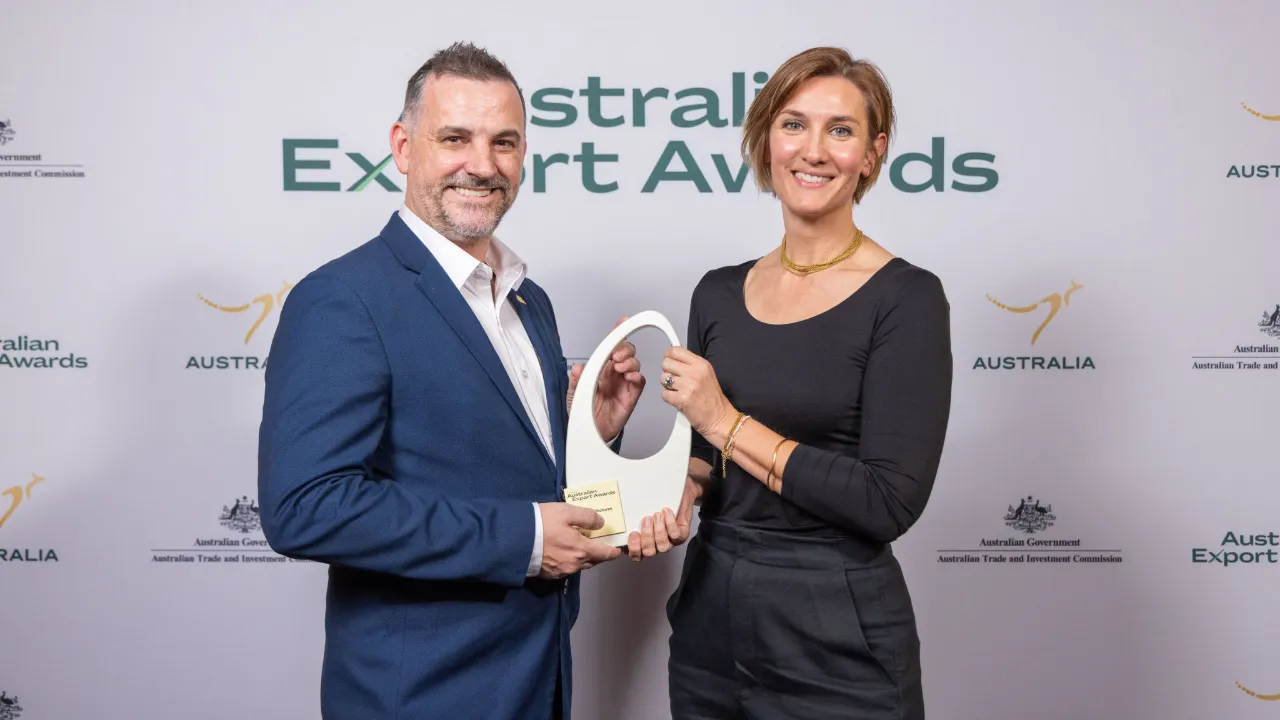
How a combination of ambition, innovation and government support helped visual effects studio Rising Sun Pictures (RSP) grow from its Adelaide beginnings into a globally recognised VFX leader and one of Australia’s prized exporters, employing more than 400 staff across their studios in Adelaide and Brisbane.
In 1995, Rising Sun Pictures was founded with a clear goal: to create world-class visual effects for the global screen industry from South Australia.
Fast-forward thirty years and their credits include global films such as Oscar-winning Gravity, X-Men: Days of Future Past, Spider-Man: Far From Home, Elvis, Indiana Jones and the Dial of Destiny and Mickey 17. Their work has been recognised across the Academy Awards, BAFTA, AACTA, VES and AEAF; their most recent project to receive an Oscar nomination was for Sinners, where they contributed around 100 highly complex shots to the film, helping realise the twin performances by Michael B. Jordan.
The accolades don’t stop there. In 2025 and 2026, their machine learning technology REVIZE was nominated for the Visual Effects Society’s Emerging Technology Award and in 2024, they were named Australia’s 2024 Exporter of the Year and won the Creative Industries category at the Australian Export Awards. That was followed by induction into the Australian Export Hall of Fame in December 2025, which is incredible recognition, particularly considering the awards acknowledge achievement across the entire Australian economy.
Rising Sun Pictures (RSP) President Alexandra Daunt Watney says the 2024 Australian Exporter of the Year was the culmination of all those years of work.
“The award represented recognition not only of artistic excellence, but of a long-term export success story built in South Australia,” Daunt Watney says.
“It validated the idea that a studio based in Adelaide can compete at the very highest level of the global screen industry and export premium creative and technical services to the world’s biggest film and streaming clients.
“The Hall of Fame induction showed that this was not a one-off achievement – it reflected repeated national export success and more than three decades of global impact.”
In those three decades Australia has also transformed into a globally competitive destination for high-end visual effects. This is no accident. That reputation is a result of exceptional work from VFX companies like RSP, as well as consistent federal and state incentives. The Australian Government’s Location Offset is a 30% tax rebate for international projects filmed or animated in Australia, while the PDV Offset is a 30% tax rebate for productions that only undertake post, digital and visual effects in Australia. Both offsets can be combined with further incentives and support from state and territory governments.
“For a business like ours, those incentives support much more than individual productions… They create the conditions for sustained investment in staff, infrastructure, R&D and pipeline development. They also help studios scale with confidence and compete internationally for ambitious, high-value work.”
This growth could be seen when RSP turned 30 in 2025 and had surpassed 400 staff across Adelaide and Brisbane. Daunt Watney says the ripple effect of the incentives goes even further.
“For the broader PDV industry in Australia… the offsets have not only attracted productions; they have helped build an ecosystem. They have supported employment growth, created career pathways, strengthened international confidence in Australian vendors, and enabled local companies to take on increasingly sophisticated and complex work,” she says.
“The incentives have been critical not just in bringing work to Australia, but in helping build a sustainable, globally respected industry.”
An Ongoing Commitment to Innovation
Part of the draw of working with Australian VFX companies like RSP is their high-quality output, but also their innovative and ground-breaking solutions.
“Innovation has always been part of RSP’s DNA,” Daunt Watney says. “It has never been something separate from the creative work.”
Historically, she says you can see that in the launch of Rising Sun Research in 2000 and products like cineSpace and cineSync, both of which emerged directly from real production needs and became a global standard for remote review and collaboration.
In 2019, RSP began collaborating with the Australian Institute for Machine Learning to explore practical ML applications for VFX. The collaboration enabled the development of the VES-nominated REVIZE toolset – RSP’s machine learning-based visual effects workflow.
Daunt Watney says REVIZE has been used for face replacement, facial performance modification, de-ageing, body replacement, digital twinning and other likeness-based adaptations.
“What makes REVIZE particularly powerful is that it puts those tools directly into the hands of artists and integrates into RSP’s broader production pipeline to deliver high-quality, production-ready results.”
It has been used across more than 21 projects, including Elvis, Shang-Chi and the Legend of the Ten Rings, Indiana Jones and the Dial of Destiny, The Fall Guy, Furiosa and Deadpool & Wolverine.
While innovation is key, Daunt Watney says RSP has an artist-first philosophy.
“Technology is not seen as a replacement for artists… It is there to empower artists – to give them better tools, greater flexibility, and more precise control over performance-driven visual effects.”
Creating a Sustainable Industry
Daunt Watney says a defining part of the RSP story is how the company built an international reputation from outside the traditional VFX hubs. Aside from their base in Adelaide, the studio launched a Brisbane studio in 2021, the same year they also became part of The Fuse Group, now Pitch Black Group. This allows them to work across the Australian screen ecosystem, with international projects such as The Fall Guy, Monarch: Legacy of Monsters season 2 and The Bluff fuelling training and their investment back into the local screen sector.
“Adelaide remains the company’s headquarters, while Brisbane has expanded the studio’s ability to support productions in Queensland and access a broader pool of talented artists and technologists.”
RSP also continues to focus on upskilling the next generation of VFX practitioners. It invested in an education partnership – initially with UniSA, and now with Adelaide University following the institutional merger – to create a career pipeline.
“[The education partnership] program has now been running for more than a decade and has helped launch over 250 careers.”
Their aim is to continue to bridge the gap between aspiring artists and workforce-ready professionals into the future – to not just employ talent but develop it too.